
Orofacial Myofunctional Therapy and Sleep Apnea
In the world of sleep medicine, Orofacial Myofunctional Therapy (OMT) has become a heavily researched, highly effective supportive treatment for obstructive sleep apnea (OSA) and chronic snoring.
Here is a breakdown of why the muscles in your mouth matter so much when you sleep, and how therapy helps.
The Connection Between Upper Airway Muscles and Sleep Apnea
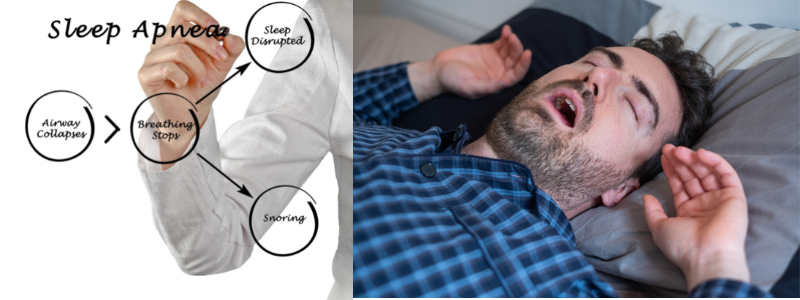
Obstructive sleep apnea occurs when the muscles and soft tissues in the back of the throat relax too much during sleep, causing the airway to collapse or become blocked.
When a person has poor myofunctional habits during the day, it directly translates to a higher risk of airway collapse at night:
-
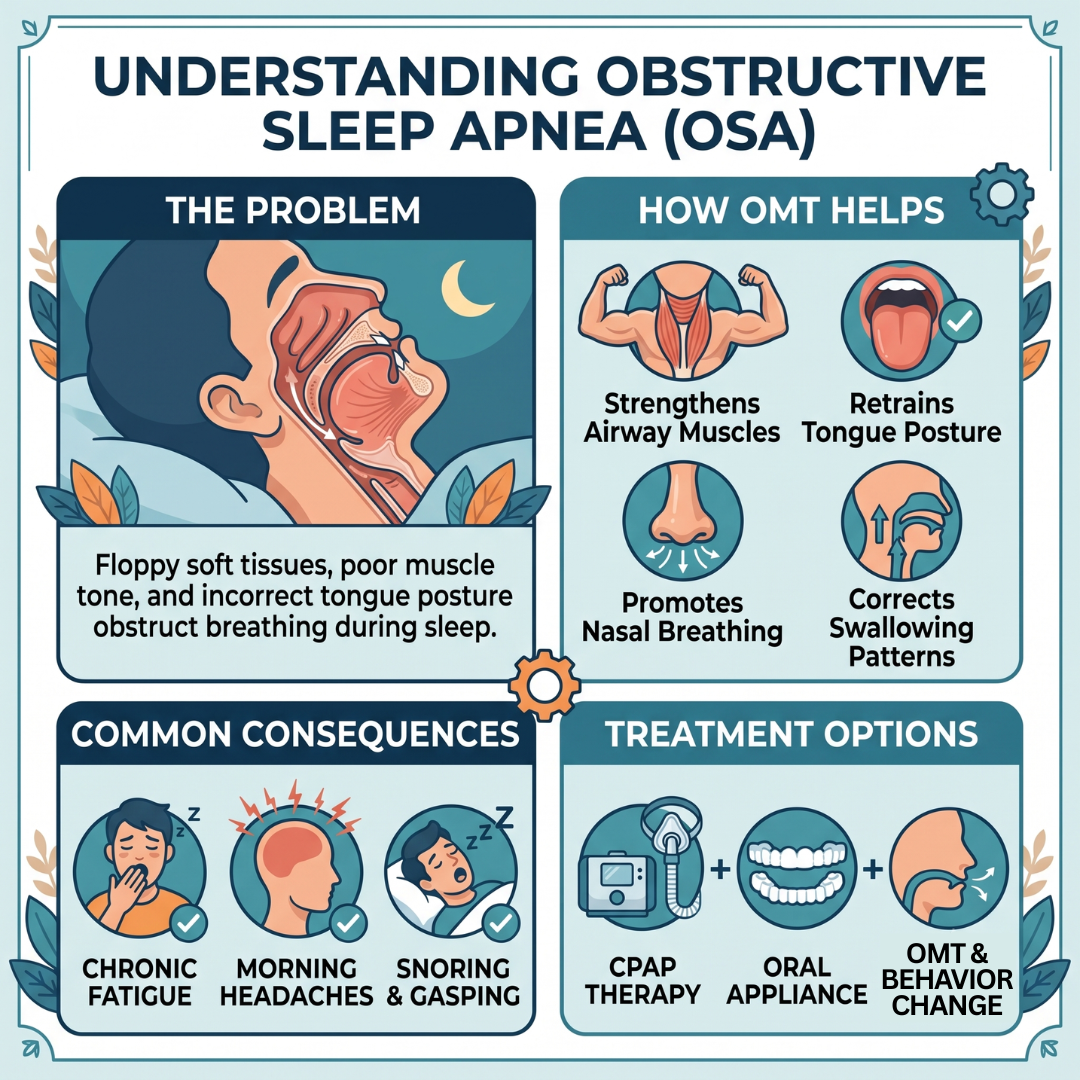
The “Floppy” Airway: Just like any other muscle in the body, if the muscles of the tongue, soft palate, and throat lack proper tone (hypotonia), they are much more likely to sag and obstruct breathing once you fall asleep.
-
Incorrect Tongue Posture: If your tongue rests on the floor of your mouth during the day instead of flat against the roof of the mouth, it is highly likely to fall backward into your throat when you lie down, physically blocking the airway.
-
Mouth Breathing: Breathing through the mouth during sleep narrows the airway space, bypasses the natural filtering and humidifying benefits of nasal breathing, and destabilizes the upper airway, making collapses much more frequent.
How Myofunctional Therapy Helps Sleep Apnea
Think of myofunctional therapy as physical therapy for your throat and airway. Clinical studies have shown OMT can reduce the severity of sleep apnea (measured by the Apnea-Hypopnea Index, or AHI) by roughly 50% in adults and up to 62% in children.
It achieves this through targeted exercises that focus on:
-
Toning the Airway Muscles: Exercises strengthen the tongue, soft palate, and pharyngeal wall muscles so they maintain structural integrity and resist collapsing when you relax at night.
-
Re-training Tongue Posture: By building the muscle memory to keep the tongue resting firmly against the roof of the mouth, it keeps the tongue forward and out of the throat.
-
Promoting Obligate Nasal Breathing: Therapy helps clear the way for exclusive nasal breathing, which naturally creates positive pressure in the airway, keeping it more stable during sleep.
-
Improving Swallowing Patterns: Correcting a tongue thrust swallow uses the deep muscles of the throat, building subconscious strength that prevents throat tissues from sagging.
OMT as Part of a Team Approach
It is important to note that while myofunctional therapy is incredibly powerful, it is rarely a standalone cure for severe sleep apnea. Instead, it works best as an adjunct therapy:
-
With CPAP: It can help patients tolerate CPAP better by reducing mouth-leaks and improving natural nasal breathing.
-
With Oral Appliances: It works beautifully alongside Mandibular Advancement Devices (MADs) by keeping the tongue active while the jaw is mechanically held forward.
-
Post-Surgery: If someone has their tonsils, adenoids, or a tongue-tie released to improve their airway, OMT is crucial to train the newly cleared space to function correctly.