

Orofacial Myofunctional Therapy and Open Bite and Cross Bite
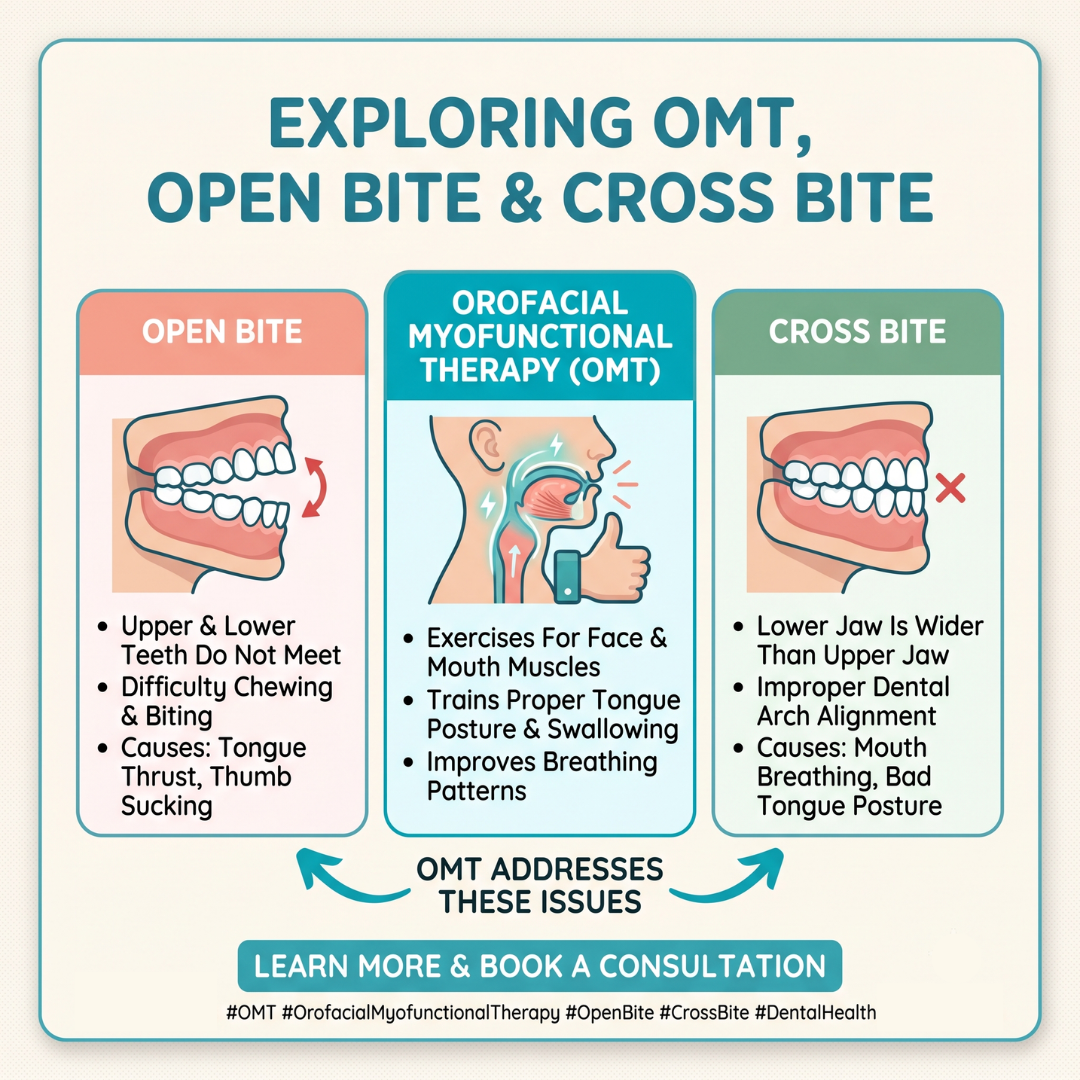
In myofunctional therapy, an open bite and a crossbite are viewed not just as structural dental alignment issues, but as direct consequences of poor muscle tone, improper tongue posture, and dysfunctional swallowing patterns.
Here is how Orofacial Myofunctional Therapy (OMT) connects to, explains, and helps manage these two types of malocclusions:
1. Open Bite and Myofunctional Therapy
An anterior open bite occurs when the upper and lower front teeth do not touch when the back teeth are clenched together, leaving a visible circular gap.
-
The Root Cause: This is almost always driven by a tongue thrust swallow or low oral rest posture. The average person swallows between 1,200 and 2,000 times a day. If the tongue pushes forward against or between the front teeth during each swallow instead of lifting to the roof of the mouth, that constant hydraulic pressure physically forces the teeth apart and prevents them from erupting properly.
-
Prolonged Habits: Extended childhood habits like thumb sucking, pacifier use, or finger biting create a physical barrier that holds the front teeth open while guiding the palate into a high, narrow shape.
-
How OMT Helps: Therapy focuses on eliminating the noxious habit and completely re-training the swallowing pattern. By teaching the tongue to move upward and backward during a swallow—rather than thrusting forward—the destructive force against the front teeth is removed, allowing orthodontic treatments to successfully close the bite and prevent it from relapsing.
2. Crossbite and Myofunctional Therapy
A crossbite occurs when the upper teeth sit inside the lower teeth when the jaw is closed, rather than slightly outside of them. This can happen on one side (unilateral) or both sides (bilateral) of the mouth.
-
The Root Cause: A crossbite is heavily tied to low tongue posture and chronic mouth breathing. The tongue is intended to act as nature’s internal orthodontic expander. When resting flat against the roof of the mouth, the tongue exerts gentle, continuous lateral pressure that structurally widens the upper jaw (maxilla) as a person grows.
-
The Muscle Imbalance: If a person rests with an open mouth, the tongue drops to the floor of the mouth. Without the internal support of the tongue, the external muscles of the cheeks (the buccinator muscles) squeeze inward unopposed. This forces the upper jaw to grow narrow, V-shaped, and structurally smaller than the lower jaw, resulting in a crossbite.
-
How OMT Helps: Therapy focuses heavily on establishing habitual nasal breathing and elevating the tongue to its proper resting home on the palate. When combined with orthodontic palatal expansion, OMT ensures that the facial muscles are balanced so that the expanded upper jaw remains stable and doesn’t collapse back into a crossbite once braces are removed.
Why the Combination Matters
Orthodontists can mechanically straighten teeth and expand jaws, but if the underlying muscular habits (mouth breathing, low tongue posture, or tongue thrusting) are not corrected, the teeth will almost always relapse into an open bite or crossbite after treatment ends. Myofunctional therapy acts as the permanent functional foundation that keeps the dental arches stable, wide, and correctly aligned.
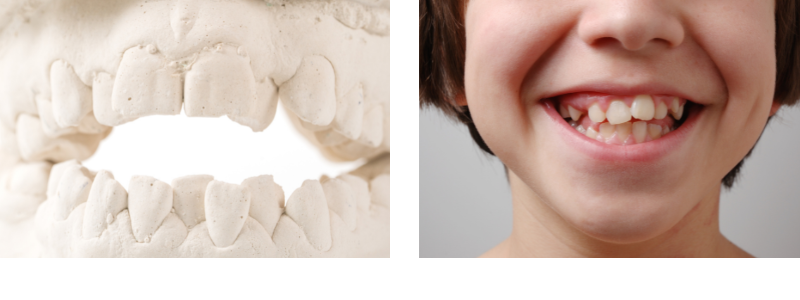
Myofunctional Therapists help the patient to achieve the goals of proper muscle function as well as improved speech, chewing and resting. Myofunctional therapy, with as few as three (3) minutes of exercise, two (2) to three (3) times a day, can create remarkable improvement.
Age does not matter, but it does take a bit longer with adults.