

Orofacial Myofunctional Therapy and Children
Finger and Thumb Sucking
Babies have natural rooting and sucking reflexes, which can cause them to put their thumbs or fingers into their mouths — sometimes even before birth. Because thumb sucking makes babies feel secure, some babies might eventually develop a habit of thumb sucking when they’re in need of soothing or going to sleep.
Many children stop sucking their thumbs on their own, often by age 6 or 7 months or between ages 2 and 4. But even a child who’s stopped sucking his or her thumb might go back to the behavior during times of stress.
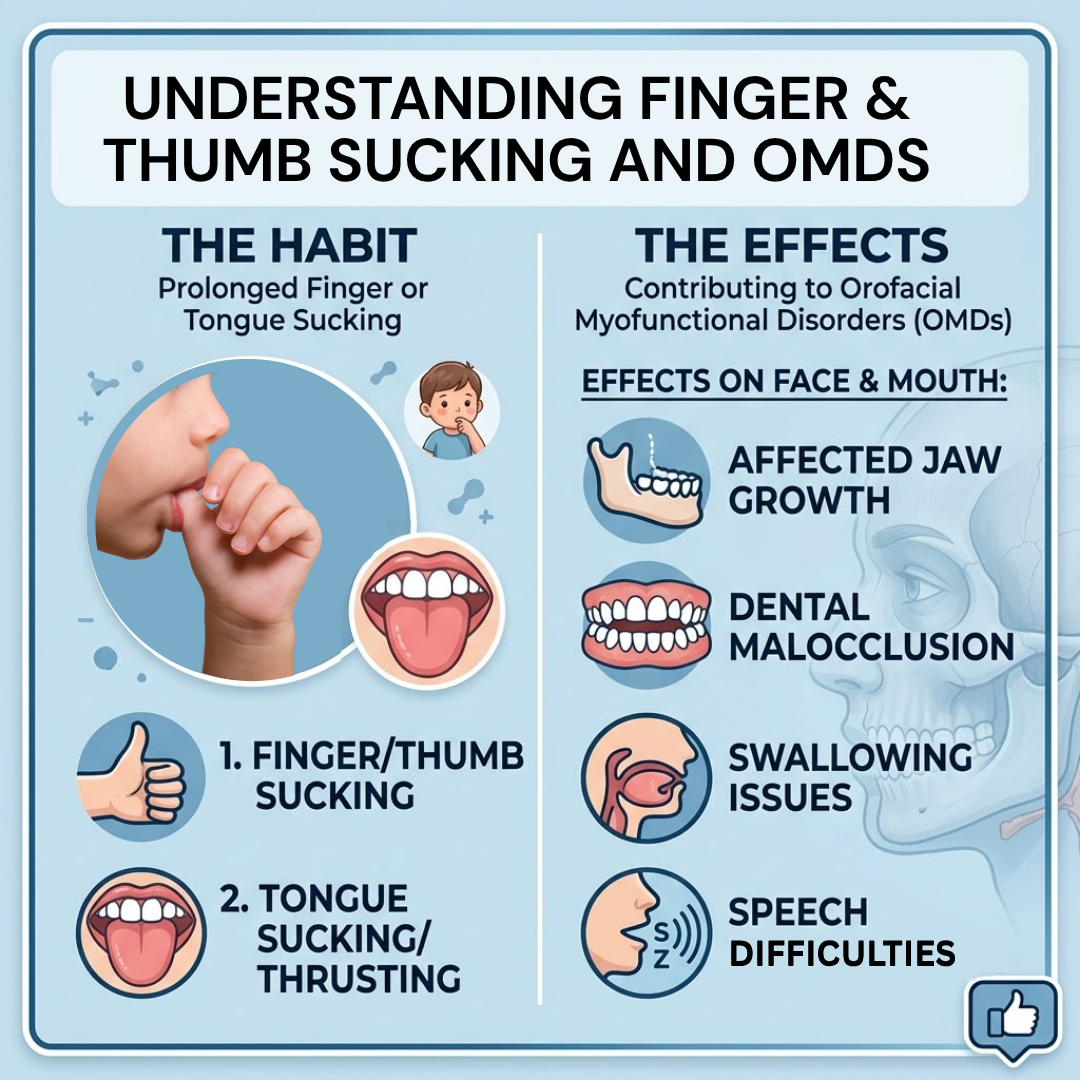
In myofunctional therapy, prolonged thumb sucking is classified as a noxious oral habit that directly disrupts normal facial growth and muscle development. While it is a natural self-soothing reflex in infants, maintaining the habit past the age of 3 or 4 can cause permanent structural changes to a child’s mouth and airway.
The Structural Impact of Thumb Sucking
When a child sucks their thumb, the thumb rests directly on top of the tongue, pushing it down to the floor of the mouth, while simultaneously applying upward and forward pressure against the roof of the mouth (the palate) and the front teeth.
This creates a combination of myofunctional and dental issues:
-
High, Narrow Palate: The constant upward pressure from the thumb molds the pliable bones of the palate into a high, narrow arch. Because the roof of the mouth is also the floor of the nasal cavity, a narrow palate restricts the nasal airway, often forcing the child to become a mouth breather.
-
Open Bite and Overjet: The thumb physically pushes the upper front teeth outward (an overjet or “buck teeth”) and prevents the upper and lower front teeth from meeting properly, creating a circular gap known as an anterior open bite.
-
Low Rest Posture & Tongue Thrust: Because the tongue is forced down and forward to accommodate the thumb, the child loses the ability to rest their tongue on the roof of the mouth. This frequently results in a tongue thrust swallow, where the tongue pushes against or between the front teeth every time they swallow, further worsening the dental misalignment.
-
Lip Incompetence: The forward shift of the teeth makes it physically difficult for the child to close their lips effortlessly at rest, leading to Weakened lip muscles and a constant open-mouth posture.
How Myofunctional Therapy Helps
Myofunctional therapy focuses on a positive, non-punitive approach to help children eliminate the habit and rehabilitate the affected muscles.
-
Habit Cessation Programs: Therapists use positive reinforcement, awareness tracking, and behavioral modifications to help the child want to stop. Instead of shaming or using physical restraints, the therapy empowers the child to take ownership of breaking the automatic habit.
-
Re-Training Tongue Posture: Once the thumb is out of the mouth, the primary goal is teaching the tongue to find its proper resting home flat against the roof of the mouth. A correct tongue posture acts as a natural, internal orthodontic expander to help widen a narrow palate over time.
-
Establishing a Lip Seal & Nasal Breathing: Specific exercises strengthen the orbicularis oris (lip muscles) to help the child comfortably maintain a closed-mouth rest posture, transitioning them away from habitual mouth breathing and into healthy nasal breathing.
-
Correcting Swallowing Patterns: Therapists eliminate the compensatory tongue thrust swallow by training the deep muscles of the throat and tongue to move backward and upward during deglutition (swallowing), rather than pushing forward against the teeth.
By addressing the root muscular habits early, myofunctional therapy can significantly minimize the amount of orthodontic treatment a child might need later in life and ensure their airway develops optimally.